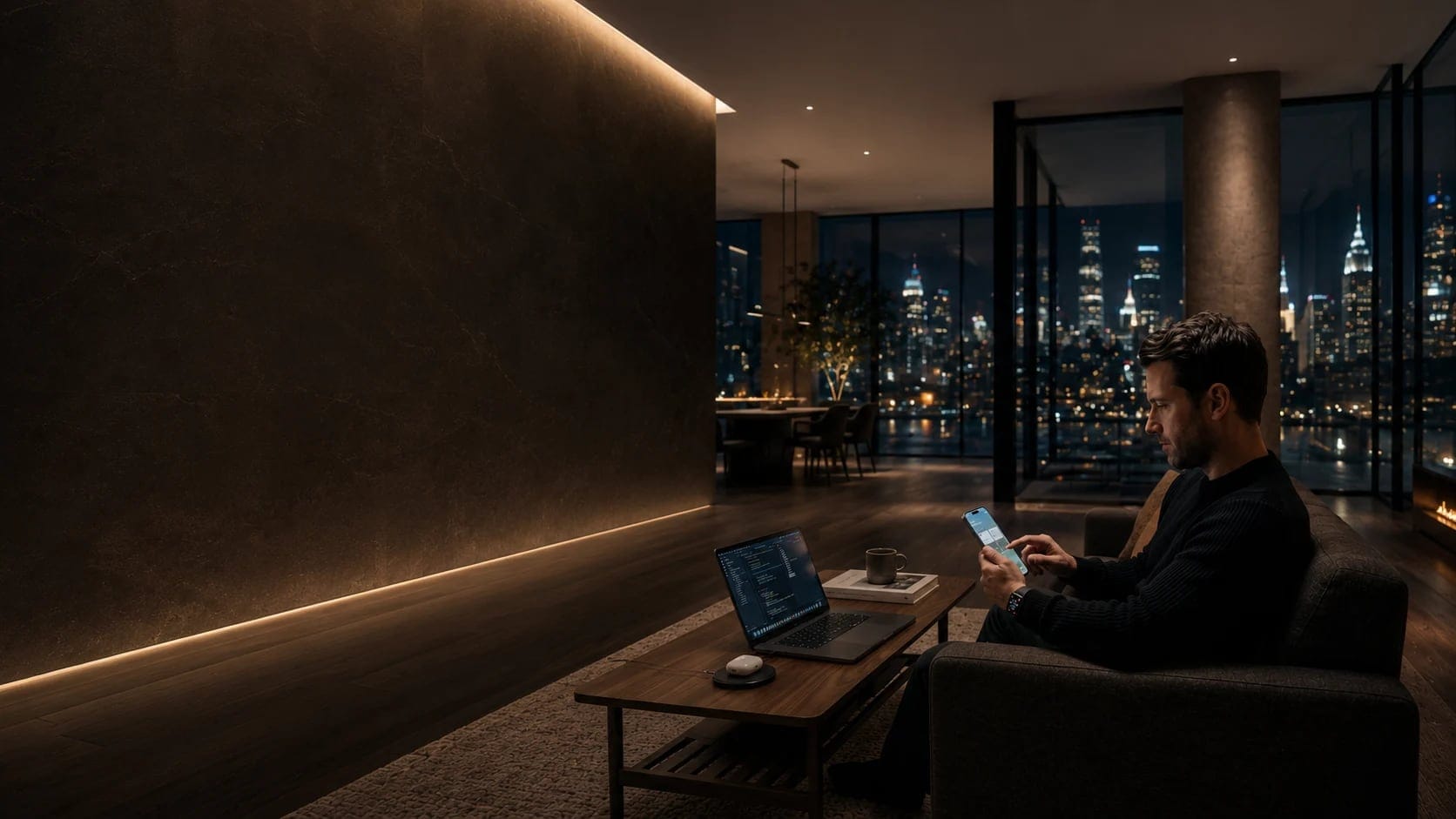
The room as part of your state
Light in the evening, sound, order and the screen next to the bed: your surroundings help decide how you experience an evening. Four areas where you can start without much effort.
VYRA EditorialSeptember 20264 min read
Most wellbeing solutions focus on you: on your body, your mind, your habits. But every moment happens somewhere. In a room with a particular light, with sounds, with things lying around or not. That room is not a neutral backdrop. It is part of how you experience your day and your evening.
Every moment happens somewhere.
We often only notice on holiday how much a room shapes us. Different light, different sounds, fewer things around us, and suddenly the same person feels different. At home we barely notice it any more, because we have grown used to our rooms.
The good news: unlike many other things, a room can be changed right away. No programme, no purchase, often just a few simple steps. Four areas are worth a closer look.
Light in the evening
During the day, light can be bright and even. In the evening, the same ceiling light can quickly feel like an extension of the working day. For many people, the evening feels more coherent when the light fades with the day: less ceiling light, more lamps at eye level or lower, warmer tones, individual pools of light instead of an evenly lit room.
Try it as a small ritual. At a fixed time, switch off the main light and switch on two or three lamps. A reading lamp, a candle or the light from the kitchen can play the same role. The room tells you that the day is over, even if your calendar still claims otherwise.
Sound
Many sounds only become noticeable once they stop: the hum of a device, the traffic outside the window, a notification chiming from the next room. Each of them briefly pulls your attention back into the day.
Silence is not the only goal. Often it fits better to choose the sound of the evening deliberately: calm music you never listen to at work, an open window, the sound of water heating for tea. What matters is the difference from the day. Notifications can take a break in the evening too, just like you.
Order
A pile of papers on the table is more than a pile of papers. It is an open task that reaches for you every time your eyes fall on it. This becomes especially noticeable when living and working happen in the same room.
You do not have to tidy the whole flat. One place that stays clear in the evening is enough: the dining table without the laptop, the armchair without the laundry, a corner that belongs only to the end of the day. If you work from home, cover your workspace in the evening or put the laptop away in a drawer. Out of sight really is, to some extent, out of mind.
A short close of the day in the room itself helps too: cups back to the kitchen, cables away, the bag in its place. It rarely takes more than a few minutes and changes how the room receives you in the evening. Not every home has a separate room for every activity. That makes small signs all the more important, the ones that give a room a different role in the evening: a throw over the chair you worked on all day, a different light, a plant in front of the screen.
Screens in the bedroom
For many people, the smartphone is the last thing they see at night and the first thing in the morning. It carries news, emails and comparisons into the bedroom, a room that really belongs to the evening and the night.
One simple change: the phone charges overnight outside the bedroom. If you use it as an alarm, replace it with a classic alarm clock. The television stays in the living room; the book may come along. The bedroom regains a clear role, and the transition into the night already begins at the door.
Start small
This is not about building the perfect room. Choose a single change and keep it for a week. Pay attention to how your evenings feel, without measuring and without judging. Then add the next one.
Over time, many small adjustments add up to a room that fits the state you want for your evening. And along the way you may notice how much of how you feel in the evening is in your own hands.
New insights by email
New articles and routines from the VYRA editorial team, at a calm pace.