Designing transitions
The working day used to have a clear edge. Today it often frays well into the evening. Why transitions between work and evening make such a difference, and how small rituals bring them back.
VYRA EditorialSeptember 20264 min read
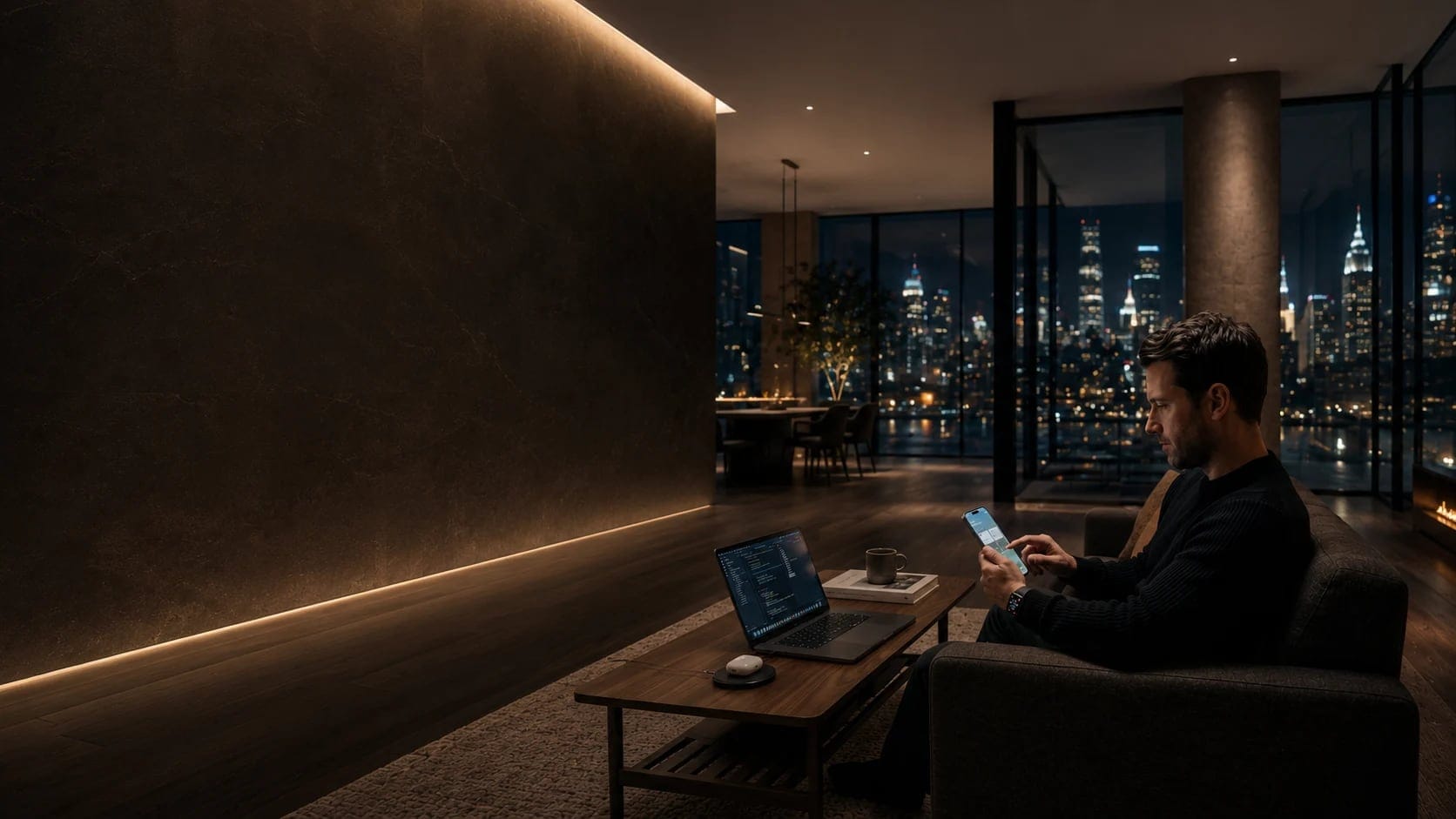
There was a time when the working day had a clear edge. You closed the office door, walked to the station, sat on the train for a while, and somewhere between two stops the day was over. That journey was not a deliberate ritual. But it did the job of one.
Today the laptop sits on the kitchen table, the last email arrives after dinner, and the phone carries the office into every corner of the home. Work no longer stops; it frays. Many people know the feeling of being at home in the evening without having really arrived.
What a transition does
Transitions are the moments in which one state ends and another begins. When everyday life no longer sets boundaries, they rarely happen by themselves. If you walk straight from a video call into the kitchen, you take the call’s frame of mind with you. This has little to do with discipline. The moment in between is simply missing.
And the step is bigger than it looks. From concentrating on a task to a conversation at the dinner table, to cooking or simply to doing nothing: these are two different ways of being present. A change like that deserves a moment of its own.
That is exactly the moment you can design. A good transition ritual is short, repeatable and has a clear beginning. It only has to do one thing: make the change noticeable.
A day needs an ending so that an evening can begin.
Closing the working day
The first part of a transition still belongs to work. Write down the one task you will start with tomorrow. Close every open window on your screen, not just the lid. Mute notifications for the evening. These small actions give you the certainty that nothing gets lost when you let go now.
Marking the change
The second part is a deliberate change. It can be entirely physical: a walk around the block, different clothes, a glass of water by the open window, a few calm breaths before you change rooms. It can also run through the senses: a different light, a particular piece of music, a cup of tea that belongs only to the evening.
What matters more than the choice of ritual is doing it in a similar way every day. Through repetition, an action becomes a signal. After a few weeks, the beginning of the ritual is often enough, and the evening is a little closer.
When the evening has already begun
Not every day can be brought to a planned close. Sometimes it is suddenly half past eight and the laptop is still open. Then it is worth catching up on the transition instead of skipping it: laptop closed, a moment at the window, a few calm breaths. A late transition is still a transition, and it counts.
Keeping rituals small
Most rituals fail because they are planned too big. An elaborate programme after work sounds good and rarely lasts. A few minutes that need no preparation have a much better chance of becoming a habit. Start with a single element and only build on it once it runs by itself. For example: laptop closed, lights down, a glass of water by the window. That is all you need to begin.
Transitions during the day
The same principle works during the day. Before focused work, a short, clear start helps: a clear desk, the phone out of reach, one obvious first task. Before an important conversation or a training session, a moment to arrive in yourself instead of stumbling in straight from the last email. Mornings know this moment too. A few minutes for yourself before the inbox opens give the day its own direction from the start.
Each of these transitions is a small decision about the state in which you begin the next part of your day. You cannot control every day. But the moments in between belong to you, and by shaping them, you help shape how the rest feels.
Try a single transition ritual for a week and pay attention to how your evenings feel. Keep what carries you, and let go of what only sounds good.
New insights by email
New articles and routines from the VYRA editorial team, at a calm pace.