Mental movies: Why we always imagine the worst and how to step out of the film
Always picturing the worst? Why your brain is not a pessimist but a protector, and how you can step out of the film in your head again.
Mike FuhrmannNovember 20266 min read
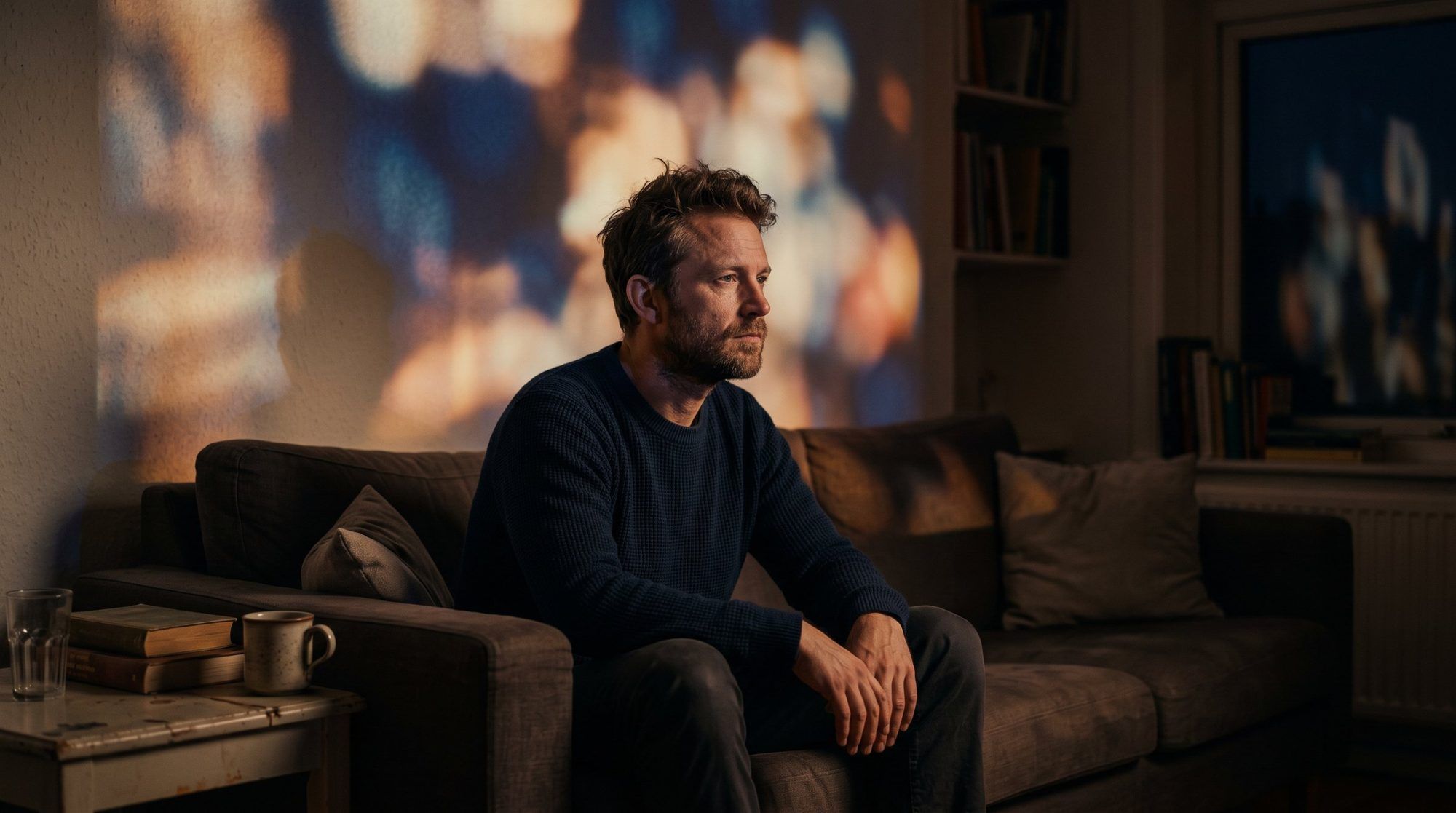
«What if ...?»
Two small words. And suddenly the film starts.
What if tomorrow's conversation goes wrong? What if the client pulls out? What if I have overlooked something? What if my message earlier came across the wrong way?
The film has no pause button. It fast-forwards, jumps into the future, imagines scenes that have never happened. And it usually ends badly.
The crazy thing about it: your body reacts as if the film were real. Your heart beats faster, your stomach tightens, your breathing becomes shallow. Even though you are just sitting on the sofa.
If you recognise yourself in this, there is nothing wrong with you. Your brain is doing exactly what it was built to do.
Your brain is not a pessimist. It is a protector.
Our nervous system has one central task: to keep us alive. To do this, it constantly searches for possible dangers. For our ancestors it was vital to interpret a rustle in the bushes as a predator once too often rather than once too rarely.
This programme is still running today. Only the dangers are different: an unanswered message, a critical look in a meeting, a figure in the quarterly report.
When your system is relaxed, it can put such signals into perspective. When it is under constant pressure, every uncertainty becomes a threat. Then not knowing feels like danger. And the brain does what it always does in danger: it plays through worst-case scenarios so that you are prepared.
Stress does not make us less intelligent. It puts our intelligence in the service of survival.
So mental movies are not a thinking error. They are a protective programme that runs too often and for too long.
Why you cannot think the film away
Most tips against negative thoughts start with thinking: think positively, question your thoughts, talk yourself round.
That can help. But when your nervous system is on alarm, arguments often do not get you far. The more you try to stop the film, the louder it gets.
The reason is simple: the film does not arise in the head alone. It arises in a state. And as long as that state is alarm, your brain will keep searching for dangers.
You do not have to change your thoughts to change your state. Often it is the other way round.
First the body comes to rest. Then the mind becomes quieter too.
The 20-storey brain: where do you spend most of your time?
I like to explain this with an image.
Imagine your brain as a house with many floors. A different state lives on each floor: deep sleep and regeneration. Relaxation and meditation. Focus and concentration. Creativity, imagination and insight. Planning, learning and performance. Flow.
A healthy nervous system is flexible. It can move effortlessly between the floors: up into focus when a task is due, down into calm when the day is over.
Many people, however, are stuck on a single floor. The floor of vigilance. Where the mental movies play. The other floors still exist, but the lift no longer goes there.
We do not have an intelligence crisis. We have an access crisis.
The good news: the lift can be set in motion again.
How to step out of the film
Try it now 1: Name the film. Tell yourself silently: «Ah, there is another worst-case film running.» Simply naming it creates a little distance between you and the film. You are not the film. You are the one who notices it.
Try it now 2: Back into the room. Look around and name five things you can see, four you can hear, three you can feel. This brings your attention back from the future into the moment in which you are actually safe.
Try it now 3: Breathe out longer. Breathe in for four seconds and out for six to eight seconds. Five times. The longer exhale is a simple signal to your body: the danger is over.
Try it now 4: Change the question. Instead of «What if ...?», ask yourself: «What do I need right now?» Calm? Movement? Someone to talk to? This question leads you back from the future to yourself.
Try it now 5: Write it down instead of pushing it away. Write the film down, in full sentences. On paper it often loses much of its power, because it can no longer go round in circles.
Light and sound: an invitation to pause
What fascinates me again and again in my work: many people who cannot quieten their minds find a different way in through the senses.
Light, sound and rhythm accompany us throughout the day: the music we like to listen to, the rhythm of a walk, the warm light in the evening.
For moments like these, we offer a wearable that invites you to take a break with light and sound. In more than 3,500 sessions that I have personally guided, I have learned: people do not need anyone to tell them how they should feel. They need space to discover for themselves what is good for them.
It does not replace a medical assessment. It is an invitation to allow yourself a break for a few minutes, without having to fight for it.
You are not the film
The mental movies will not disappear for ever. And they do not have to. They are a part of you that wants to protect you.
The difference is: you can learn to notice when the film is running. And you can learn to change floors.
The opposite of mental movies is not an empty head. It is the freedom to choose which film you watch.
The next time «What if ...?» comes up, pause briefly and ask yourself: what state am I in right now?
Frequently asked questions
Why do I always imagine the worst?
Your brain is not a pessimist but a protector. It plays through possible dangers so that you are prepared. When the nervous system is on alert for a long time, the film keeps running even when there is no danger at all.
How do I step out of the mental movie?
Do not fight the thoughts; change the state instead. The article names five steps: name the film, come back into the room through your senses, breathe out for longer, ask «What do I need now?» instead of «What if ...?» and write the film down. Thoughts often change when the state changes.
What is the 20-storey brain?
An image from the article: the brain is like a house with many floors, each home to a different state, from calm to focus to creativity. Many people are stuck on the floor of alertness, and the lift no longer goes to the others. We do not have an intelligence crisis; we have an access crisis.
Your next step with VYRA
Would you like to experience for yourself what a break with light and sound feels like? Book a personal session or enquire about the VYRA Reset Lounge for your company.

Co-Founder VYRA · Human State & MIND
Mike Fuhrmann is co-founder of VYRA Wellness and a Human State Architect. He has personally guided more than 3,500 sessions and speaks internationally about overstimulation and the art of switching off.
New insights by email
New articles and routines from the VYRA editorial team, at a calm pace.