
The mask that protects you, and slowly eats you up
Successful, but empty inside? Why the mask we wear at work protects us at first, then drains us, and how to find your way back to yourself.
Mike FuhrmannNovember 20265 min read
For five years I was CMO of Generali Switzerland.
From the outside, it looked like everything you could wish for. Responsibility. Teams. Budgets. A title that opens doors.
I even set up rooms there dedicated to employee health.
And me?
I was successful. And empty inside.
It took me a long time to understand what had happened. I hadn't lost myself because I worked too little. I had lost myself because I had become too good at being someone.
Life happens to me
This series tells my journey in three sentences.
Life happens to me. Life simply happens to me. I function, react, deliver.
Life happens for me. What happens begins to make sense, even the hard parts.
Life happens through me. What I have lived flows on, to others.
This first part belongs to the first sentence. To the time when I wore a mask without even noticing.
What the mask really is
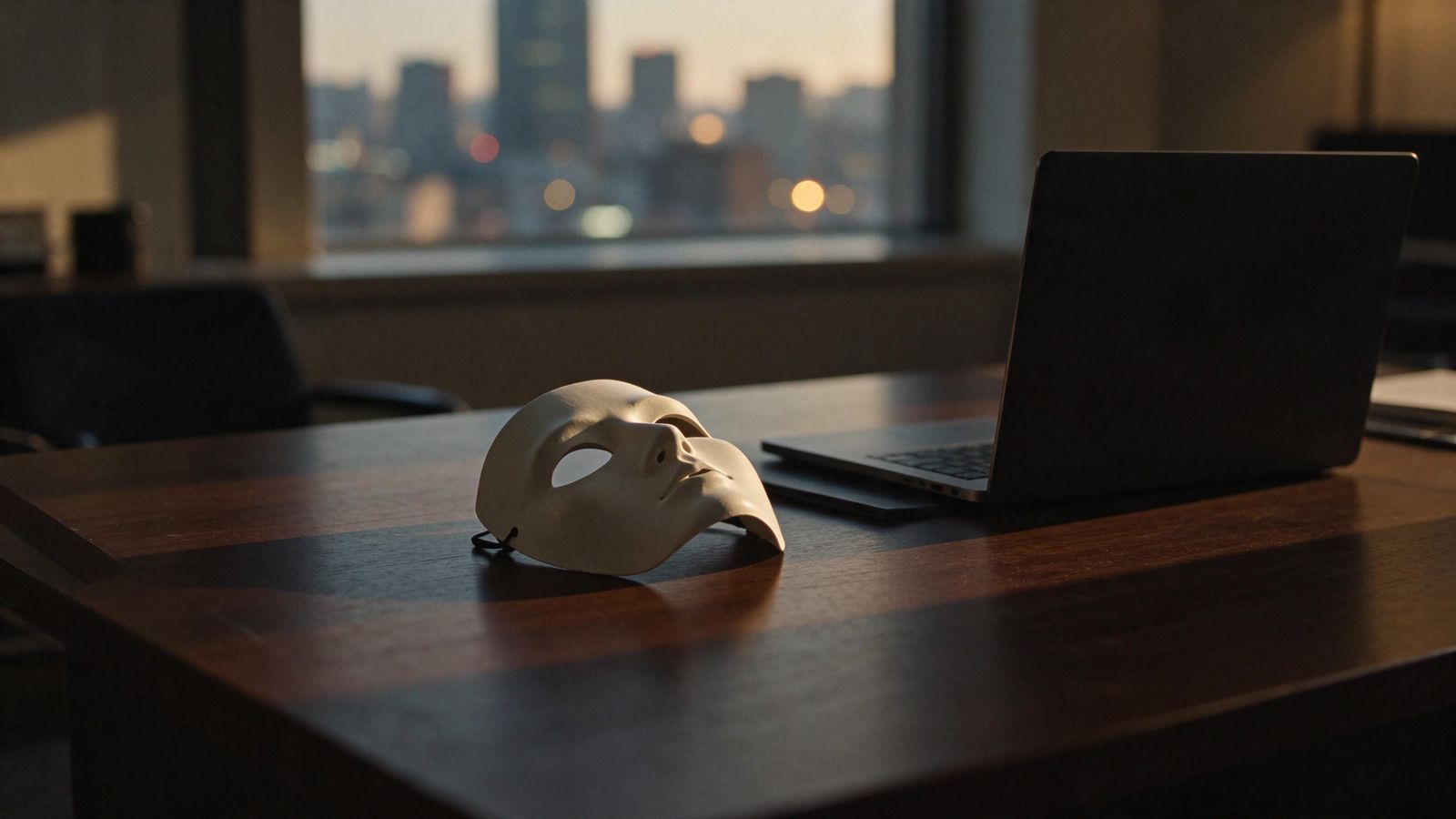
The psychiatrist C. G. Jung had a name for this mask: persona.
The word comes from the theatre. In antiquity, actors wore masks so the audience could recognise their role.
Jung meant something entirely ordinary. The persona is the side of us we show the world. The professional one. The polite one. The reliable one.
And at first, there is nothing wrong with that.
Without a persona we couldn't chair a meeting, handle a difficult conversation or welcome a client while things are falling apart at home. The mask protects us. It gives us something to hold on to in a world full of expectations.
The mask is not the problem. The problem begins when we believe we are the mask.
When you spend years being the strong one, the reliable one, the one who has everything under control, something quiet happens. You forget that it is a role.
You no longer live your life. You manage it.
How to tell you've confused yourself with the mask
There is no big moment when it happens. It happens in small steps:
- You smile in meetings when you don't feel like smiling.
- You say yes to projects that bore you inside.
- You hold back ideas to keep the peace.
- You know exactly what is expected of you, but no longer what you actually want.
- At the weekend you feel empty, but you can't say why.
None of these is dramatic on its own. Together they add up to a life that looks good and doesn't feel like yours.
What this has to do with your nervous system
Wearing a mask is work.
Your nervous system has to keep checking: What do others expect? How am I coming across? What must I not show right now?
That is vigilance. And for the body, vigilance means staying on alert. It never really comes to rest, because it is never fully with itself.
In the short term, that's fine. We are built to adapt.
But over the years, adapting becomes a permanent state. And a nervous system that is permanently on alert loses something important: access to yourself.
Your creativity is still there. Your curiosity too. Your warmth, your humour, your ideas. You just can't reach them anymore.
That is exactly how it felt for me. Not empty because nothing was left. Empty because everything was hidden behind the mask.
Who are you without a role?
Today I often ask a simple question, in workshops, in conversations, and to myself:
Who are you when you don't have to play a role?
Not as a CEO. Not as a mother, father, partner or colleague. Not as the person people know you as.
Many people fall silent at this question. Not because they have no answer, but because they haven't asked it in a long time.
That is no reason to throw everything away. You don't have to burn the mask. You can keep it, as a tool.
But a tool is something you can also put down.
Quick exercise: take off the mask for two minutes
Find a moment between two appointments today. Sit down, phone away.
- Consciously tense your facial muscles: forehead, jaw, mouth. Hold for five seconds.
- Let go. Let your face soften, your jaw relax, your mouth open slightly.
- Breathe out three times, each exhale longer than the inhale.
- Ask yourself: How am I really doing right now?
You don't have to do anything with the answer. It's just about feeling, for a moment, who is sitting underneath the mask.
The first step
I didn't take off my mask in a day. It took years. There were breaks, detours and relapses. That is what this series is about.
But it all began with one insight:
I am not my role. I only wear it.
If you read that sentence and something inside you nods, you are not alone. And you may already be well on your way.
Your nervous system in focus
For the body, wearing a mask means constant tension. In addition to the exercise above:
- Notice the moment the mask goes on. Before a meeting, when you walk into the office: what changes in your jaw, shoulders, voice?
- Release the tension on purpose. Between two appointments: drop your shoulders, loosen your jaw, take one long exhale.
- Take short breaks without a role. Two minutes at the window, no phone, no task. Your nervous system learns that there are moments when it doesn't have to perform.
A break with VYRA
Would you like to experience for yourself what a break with light and sound feels like? Book a personal session or enquire about the VYRA Reset Lounge for your company.

Co-Founder VYRA · Human State & MIND
Mike Fuhrmann is co-founder of VYRA Wellness and a Human State Architect. He has personally guided more than 3,500 sessions and speaks internationally about overstimulation and the art of switching off.
New insights by email
New articles and routines from the VYRA editorial team, at a calm pace.